For more than three centuries, the Knights’ Academy in Legnica has reflected changing ideas about education, ambition and the role of historic spaces.
Founded in 1708, the Knights’ Academy was created as an elite educational institution for young noblemen from across Silesia and beyond. Over more than three centuries, the building and the school it housed reflected changing political powers, educational ideals and the evolving role of Legnica itself.
Today, an exhibition prepared by the Copper Museum in Legnica explores both histories together. Located in the branch of the Knights’ Academy, it presents the story of the institution alongside the development of one of the city’s most significant historic buildings.
An Academy Designed for Future Leaders
The Knights’ Academy, officially known as Academia Regia Josephina Equestris Lignicensis, was established by Emperor Joseph I of Habsburg in 1708. Its purpose was to educate young noblemen for future roles in state administration and military leadership.
The academy offered an unusually broad curriculum for its time. Students studied subjects including law, history, geography, mathematics, architecture, languages, philosophy and military sciences. Training also included practical skills associated with noble education, such as horsemanship, fencing, dancing and public speaking.
The institution was also notable for allowing both Protestant and Catholic students to study there, reflecting the complex religious landscape of Silesia in the early 18th century.
Over time, students arrived from across Silesia, the Habsburg Monarchy, German states and the Polish-Lithuanian Commonwealth. Among those connected with the academy were members of prominent families, including the Lubomirski, Zamoyski, Szembek, Ossoliński and Poniński families.
A Monumental Building Through Changing Times
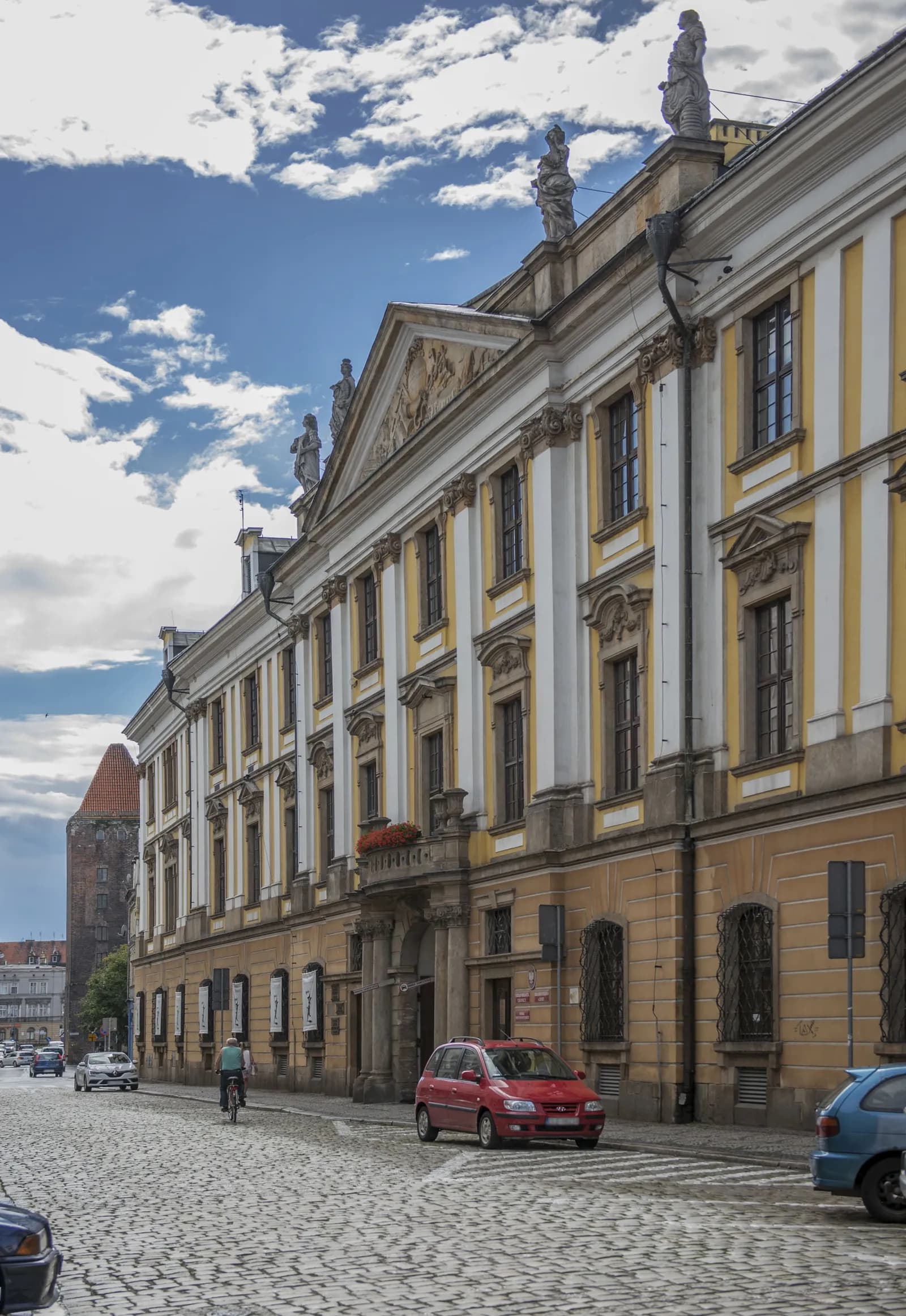
The Academy’s current building was constructed in stages between 1709 and 1738, with later alterations reflecting changing needs and historical circumstances.
The first new structure was a riding arena built in 1709, designed by Christian Gottlieb Hertel, a mathematics professor at the Academy. Plans for a much larger quadrangular complex followed, creating the monumental building that would eventually occupy an entire city block.
Construction of the main complex began in 1728 under the supervision of Legnica master mason Johann Jacob Scheerhofer. However, political changes interrupted the final stages of development when Prussia took control of Silesia in 1740. The northern wing was completed much later, in the early 19th century.
The building continued to evolve alongside the institution. In 1811, the Knights’ Academy became a Royal Prussian grammar school, later known as the Gymnasium Johanneum. Until 1944, the site remained an important centre of education.
After the Second World War, the building entered another chapter of its history. Between 1945 and 1978, it was used by the Northern Group of Forces of the Soviet Army. Following its return to Polish administration, conservation and adaptation works began, allowing the historic complex to take on new cultural roles.
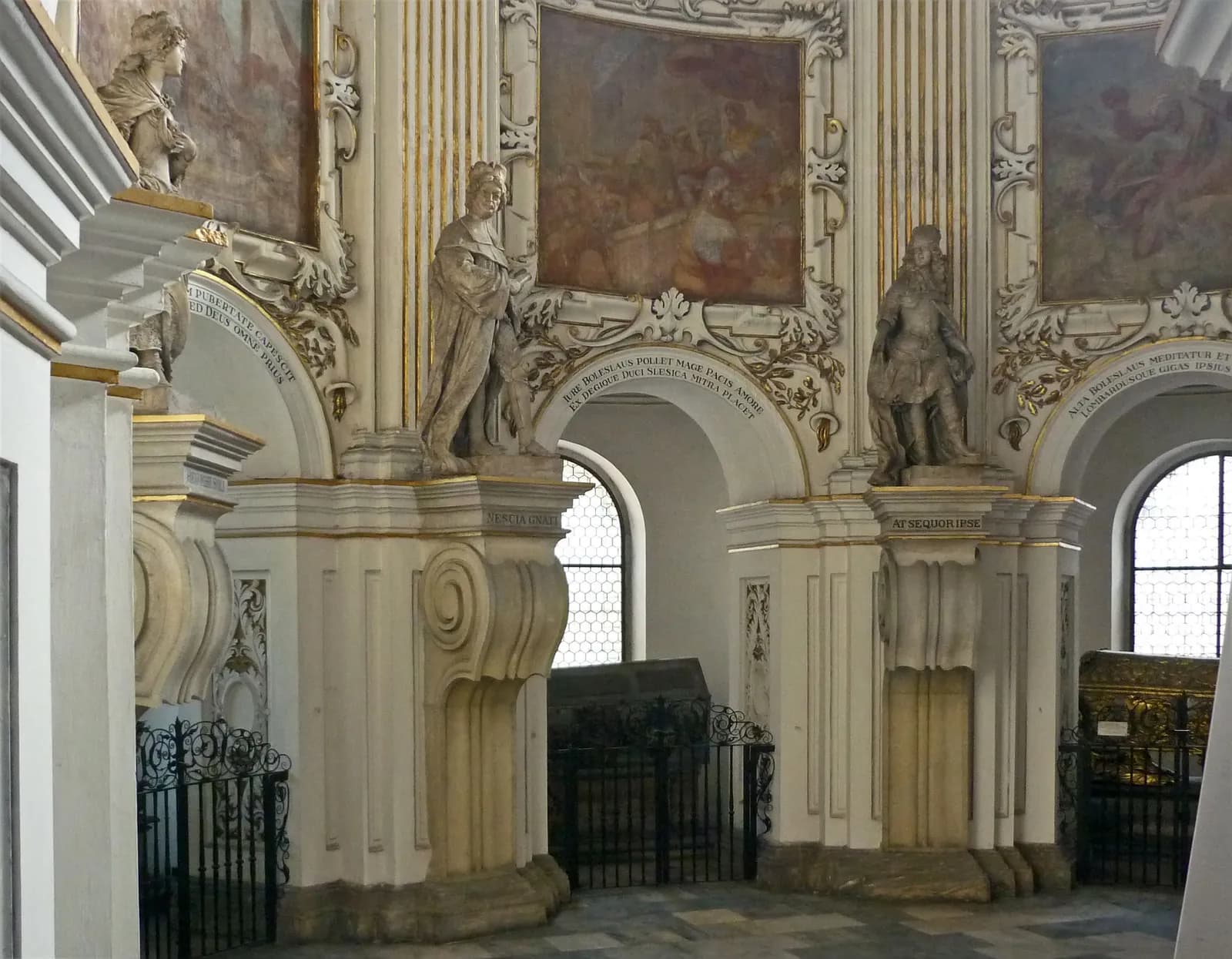
Today, the Knights’ Academy houses several institutions, including the Legnica Cultural Center, the Music School Complex, the Civil Registry Office and the Copper Museum.
Discovering the Academy Through Objects and Architecture
The exhibition at the Knights’ Academy brings together the histories of the school and the building through documents, portraits, artworks and objects connected with the institution’s past.
A central element of the display is a 1:100 scale model of the building, allowing visitors to explore its construction phases and understand how the rooms functioned in the 18th century.
Through these exhibits, the Academy is presented not only as an architectural monument, but as a place shaped by the people who studied, taught and worked there. The exhibition shows how educational traditions, political changes and architectural development became intertwined within one of Legnica’s most important historic sites.
Visitor Information
Knights’ Academy Branch
Copper Museum in Legnica
Opening Hours
Winter season (1 October–31 May)
Tuesday–Friday: 10:00–17:00
Saturday: 11:00–17:00
Summer season (1 June–30 September)
Wednesday–Friday: 10:00–17:00
Saturday–Sunday: 11:00–17:00
Monday: closed
Tickets
Admission to museum exhibitions in both buildings:
Standard ticket: PLN 20
Reduced ticket: PLN 10
A ticket purchased in one building allows entry to both museum locations.
Foreign-language guided tour: PLN 120
Groups of up to 30 people must be registered at least 7 days before the planned visit. Free admission every Wednesday (tickets required on Saturdays), Free admission for group leaders
The Knights’ Academy stands as a reminder that historic buildings are shaped by more than architecture alone. Across more than three centuries, this place has reflected changing ideas about education, society and culture, preserving the stories of those who studied and worked within its walls.