When the last male Silesian Piast died in 1675, his mother responded not with a simple tomb, but with a Baroque monument to an entire dynasty.
Legnica's history is inseparable from the Piast dynasty. For centuries, members of the family ruled territories in Silesia, leaving their mark on the city's architecture, political history and cultural identity. Yet few places express that legacy as completely as the Mausoleum of the Silesian Piasts inside St John the Baptist's Church.
Created between 1677 and 1679, the mausoleum was conceived after the death of George William, the last male representative of the Silesian Piast dynasty. His death in November 1675 brought the Legnica-Brzeg line to an end. For his mother, Duchess Louise of Anhalt, the loss was both personal and historical. She commissioned a family mausoleum that would commemorate her son and relatives while presenting the Piasts as a dynasty whose history extended far beyond the lives of those buried there.
The decision was significant because the chapel was not built as a separate monument. Limited resources led Louise to incorporate it into the Gothic Church of St John the Baptist, transforming the existing chancel into a circular Baroque chapel beneath a dome. The architectural design is attributed to the Italian builder Carlo Rossi, who had worked for the Piast court in Oława.
A final chapter written in stone, metal and paint
The mausoleum's unusual character comes from the way its different artistic elements work together. Architecture establishes the space, sculpture gives the dynasty a human presence, while painting expands the story beyond the people buried beneath the chapel.
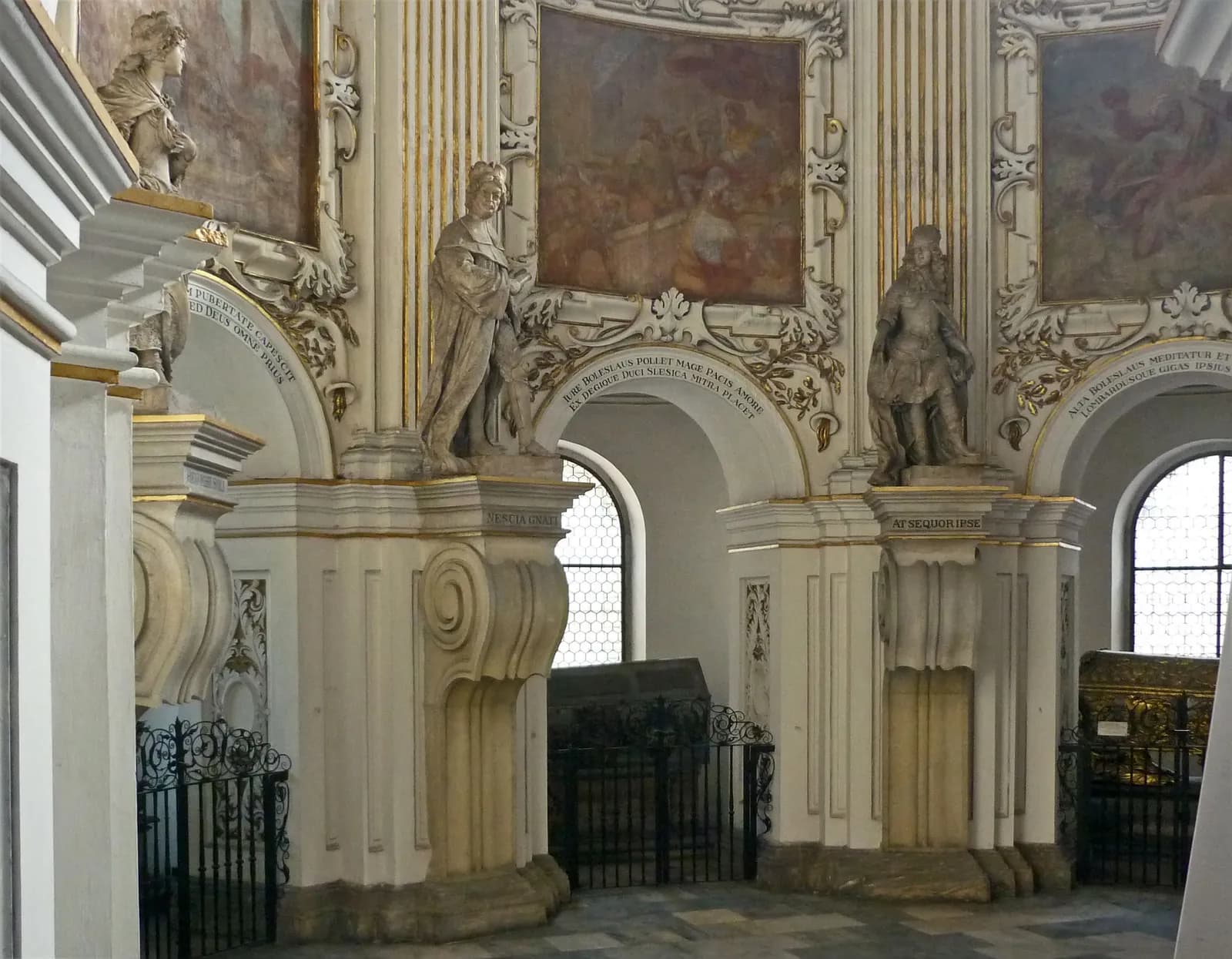
At the centre of the story are the sarcophagi. Five metal coffins occupy niches in the lower part of the chapel, including those of Duke Louis IV, Duke Christian of Legnica, Louise of Anhalt and George William. Another belongs to Sophia Elizabeth, first wife of George Rudolf. The remains of other Piast family members were also transferred from the former crypt to the mausoleum in the early nineteenth century.
George William's sarcophagus is particularly expressive. Made of silver-plated copper with gilded decoration, it incorporates symbols associated with rulership, mortality and hope. Four figures representing virtues of a good ruler support the young prince's coffin, while the broken heraldic emblem beneath his mitre signals the end of the dynasty. The imagery turns a burial object into part of the mausoleum's wider argument about succession, loss and remembrance.
The four alabaster figures by Viennese sculptor Matthias Rauchmiller are equally important. They portray George William, his parents Christian and Louise, and his sister Caroline. Rather than standing as conventional portraits, the figures appear to address one another, creating an imagined final family conversation. Their words, inscribed on the pedestals, reinforce the sense of grief and uncertainty surrounding the dynasty's extinction. Rauchmiller's work is regarded as an outstanding example of seventeenth-century portrait sculpture in Silesia.
The ceiling turns family history into a story of time
Above these figures, the painted decoration widens the perspective. The fresco in the dome depicts Helios stopping his chariot before the constellation of Cancer. In the context of the mausoleum, the halted chariot becomes an image of time itself being brought to an end, reflecting the extinction of the Piast line.
Below it, painted scenes connect the family memorial with a much longer dynastic history. The cycle reaches back to the legendary Piast and early rulers of Poland, before moving through major figures of the Piast tradition and into the history of the Silesian branches of the family.
The programme therefore does something more ambitious than commemorate several individuals. It places the deaths of the Legnica-Brzeg Piasts within a narrative stretching across centuries. The mausoleum becomes a visual history of dynastic continuity, while its central theme remains the fragility of that continuity.
This was also a carefully considered political and literary statement. Louise was not simply the patron of the project. She shaped its overall concept, while the poet Daniel Casper von Lohenstein, associated with the Piast court, contributed to the selection and interpretation of its symbolic elements and composed the Latin inscription on the foundation plaque.
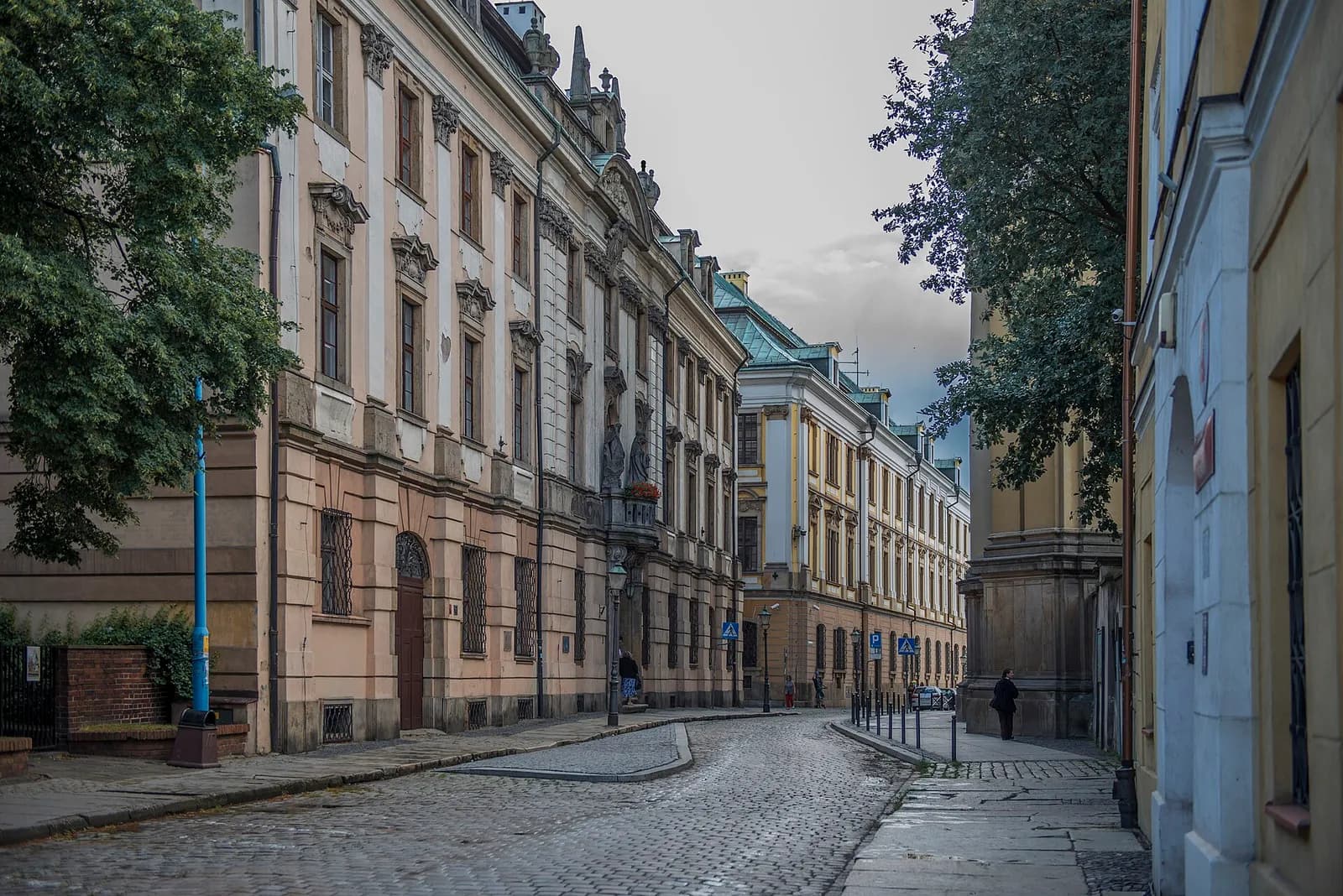
The later history of the church makes the survival of the mausoleum particularly remarkable. When the Gothic nave of St John's was demolished and replaced with the present Baroque church in the early eighteenth century, the former choir and mausoleum were preserved and incorporated into the new building as a side chapel. The arrangement remains today.
That continuity gives the monument a particular resonance in modern Legnica. The Piast dynasty itself disappeared from political life, but its memory remained embedded in the city. Today, the Mausoleum is part of the historic landscape managed for visitors by the Copper Museum in Legnica, allowing a place created to preserve dynastic memory to continue serving as a point of contact with the city's medieval and early modern past.
The mausoleum is therefore more than a burial chapel. It is a carefully constructed meditation on what remains after a ruling family disappears: portraits, symbols, inscriptions, architecture and stories. In Legnica, the end of one dynasty became the beginning of a monument whose purpose was to ensure that its history would not end with it.
Visitor Information
Mausoleum of the Silesian Piasts
Church of St John the Baptist
ul. Ojców Zbigniewa i Michała 1, Legnica
Visiting:
Wednesday–Friday: 10:00–14:00