Beneath Legnica's streets lies a hidden landscape of shelters, cellars, military installations and passages that has fuelled stories of a secret underground city for generations.
Some of it is firmly documented. Other stories are harder to pin down.
Rumours of tunnels linking Soviet military bases, the railway station and the former hospital in Lasek Złotoryjski have circulated for decades. There have also been stories of medieval passages, hidden treasure and extensive underground routes beneath the historic centre.
The reality is less tidy, but no less fascinating. Legnica genuinely has an extensive collection of subterranean structures, built at different times and for very different purposes. The difficulty is knowing where the documented history ends and the legend begins.
The underground city that really exists
The first thing to establish is that Legnica does have a significant underground heritage.
The city's subterranean spaces include historic cellars, wartime air-raid shelters, railway structures and installations connected with the military history of the 20th century.
In December 2025, city officials, the State Fire Service, building inspectors and representatives of the Muzeum Miedzi inspected a number of former shelters and other underground structures across Legnica.
The sites included areas around Park Miejski, ul. Jordana, ul. Hetmańska, ul. Chojnowska, ul. Skarbowa, ul. Rzeczypospolitej and ul. Piłsudskiego, as well as railway facilities and the area around the railway station.
Some entrances had been sealed for years and had to be reopened for inspection.
The condition of the structures varied considerably. One shelter contained between 30 and 40 centimetres of standing water, while wooden flooring had deteriorated. Other underground spaces were found to be in considerably better condition.
The inspection provides a useful reality check for the more dramatic stories about Legnica's tunnels. There really are underground structures scattered around the city, including beneath railway property. But that does not automatically mean they were all connected.
Legnica's railway station and the tunnel stories
The railway station occupies a central place in many of Legnica's underground stories.
During the 2025 inspection, underground protective structures beneath railway facilities and the station platform were among those examined.
That is significant because the station has long featured in local accounts of secret underground routes.
Some stories describe passages running from the station towards former Soviet military installations. Others have claimed that underground railway lines once connected different parts of the Soviet military complex.
There is currently no reliable evidence showing that a vast tunnel network connected the station with all of these locations.
Historians have questioned some of the proposed routes, particularly because of the city's underground watercourses and the practical difficulties involved in constructing such passages.
The Soviet period left its own underground mystery
Legnica's association with the Soviet military is central to the modern mythology surrounding its underground.
From the end of the Second World War until the withdrawal of Soviet forces in 1993, the city was one of the most important Soviet military centres in Poland.
The scale of the Soviet presence was substantial. In a declassified US intelligence report from 1955, American analysts estimated that around 15,000 Soviet troops were stationed in and around Legnica.
The same report referred to a major Soviet construction site near the Kaczawa River and mentioned reports of underground installations in the area.
The existence of such intelligence reports does not prove the stories about a huge underground complex. It does, however, show that Soviet construction and military infrastructure around Legnica attracted attention well beyond Poland during the Cold War.
The secrecy surrounding the Soviet presence also created ideal conditions for rumours to grow.
Large areas were inaccessible to ordinary residents. Buildings disappeared behind military fences. Information was limited, and even people living close to Soviet installations often had little idea what was happening inside them.
When the Soviet forces eventually left in 1993, many questions remained.
The former Soviet hospital at Lasek Złotoryjski
Perhaps the best-known tunnel story concerns the former Soviet hospital in Lasek Złotoryjski.
The hospital was a major medical complex covering around 19,000 square metres and was used as an evacuation hospital for wounded Soviet soldiers.
After the Soviet withdrawal, the site was handed over to the city. It subsequently fell into disrepair, leaving behind one of the more evocative reminders of Legnica's Soviet past.
Local stories claim that underground passages connected the hospital with the railway station.
The idea is certainly plausible enough to make a good story. A military hospital serving a large Soviet garrison, combined with Legnica's railway infrastructure and the secrecy surrounding the Soviet presence, naturally invites speculation about how personnel and supplies might have been moved.
But no reliable evidence has been found establishing a tunnel running from the hospital to the main railway station.
Academic research into memories of Soviet Legnica records the story as part of the city's oral history. It is valuable evidence of what former residents remembered hearing, but it should not be presented as proof that the tunnel existed.
That distinction is particularly important when discussing Legnica's underground history.
What people remembered about the "Little Moscow"
Legnica was sometimes described as a Polish "Little Moscow" or “Second Moscow” because of the scale of the Soviet military presence.
The nickname captures something important about the atmosphere of the city during those years.
The Soviet military operated behind a layer of secrecy, with its own facilities, shops, schools, housing and infrastructure. For many Polish residents, there was a parallel city within Legnica that was visible but largely inaccessible.
Oral-history research has recorded stories of underground passages, secret railway lines and hidden connections between military facilities.
Some accounts describe routes beneath the railway station. Others speak of passages leading from military buildings into the wider city.
These memories should not simply be dismissed as inventions. They form part of the social history of the Soviet period.
At the same time, memories recorded decades later can combine things that people personally saw with stories they heard from friends, neighbours or former employees.
That makes them an excellent starting point for investigation, but not a substitute for architectural plans, military records or archaeological evidence.
The older cellars beneath Legnica
The underground story did not begin with the Soviet Union.
Legnica's historic centre contains much older subterranean spaces, particularly cellars associated with historic buildings.
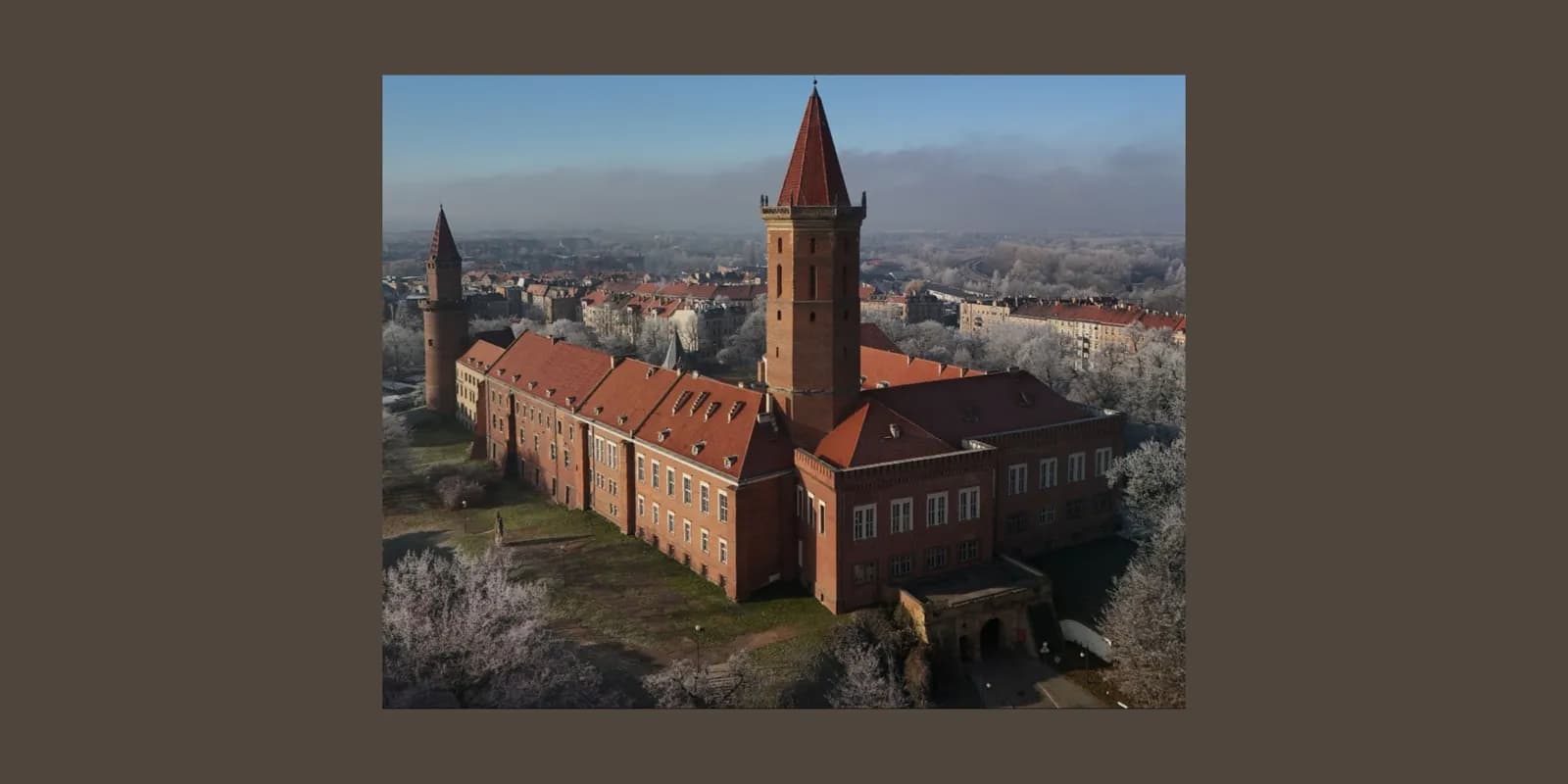
The Piast Castle is one of the clearest examples.
The castle has medieval origins, and its surviving cellars contain architectural remains from different stages of the complex's development. The underground areas have occasionally been opened to the public during heritage events, giving visitors a glimpse of parts of the building that normally remain inaccessible.
These historic spaces have also contributed to stories about secret passages beneath the city.
Legends of underground routes connecting the castle with religious buildings appear periodically in accounts of Legnica's history.
There are also stories linking hidden chambers and underground passages with the Knights Templar and buried treasure.
There is no reliable archaeological evidence establishing a secret Templar tunnel network beneath Legnica, nor evidence confirming that Templar treasure remains hidden under the city.
For now, those stories belong firmly to Legnica's folklore.
What remains to be discovered?
The most interesting question today is not whether Legnica has a giant secret tunnel running beneath the entire city.
There is no convincing evidence for that.
The more useful question is how much of the city's genuine underground infrastructure remains undocumented or inaccessible.
The inspections carried out in 2025 showed that previously sealed underground structures still exist in different parts of Legnica.
The Muzeum Miedzi has also continued to explore lesser-known parts of the city's history through its historical walking programme, including places that are normally inaccessible.
There is therefore a real opportunity for further research.
Old architectural plans, railway records, wartime documentation, Soviet-era maps and declassified intelligence material could potentially help establish where the various underground structures were located and what they were built to do.
Comparing those records with oral histories could be particularly revealing.
A story repeated by generations of Legniczanie may turn out to be completely fictional. It may also contain a fragment of something real that has been distorted over time.
The tunnels beneath Legnica are still telling their story
For now, the evidence points to a city with many underground spaces rather than one confirmed subterranean network.
The shelters are real. The historic cellars are real. Underground railway and military structures are real. The Soviet military presence was real, and foreign intelligence agencies were interested in what was being built around the city.
The supposed connections between all these places are much harder to prove.
That leaves Legnica with an intriguing underground history that sits somewhere between archaeology, Cold War history and local folklore.
Perhaps the most compelling stories are not the ones about a mythical tunnel stretching beneath the entire city, but the genuine structures that have been sealed, forgotten or only partially explored.
There are still doors beneath Legnica that have not been opened for decades.
And until the records, plans and structures have all been properly examined, some of the city's underground stories will remain just that: stories.
See more: The Knights’ Academy in Legnica: A Building Where History and Education Meet
Sources: Burszta, Jędrzej & Grębecka, Zuzanna. (2015). Mówiono "druga Moskwa". Wspomnienia legniczan o stacjonowaniu wojsk radzieckich w latach 1944-1993. Źródła etnograficzne.,radiowroclaw.pl, gazetawroclawska.pl, legnica.travel
Image credit: By Marek Śliwecki, Wikimedia Commons, CC BY-SA 4.0